Cravings Offer Information
What If Your Cravings Were Information?
We spend a lot of energy fighting cravings. Distracting ourselves from them, trying to “be good,” white-knuckling our way through the afternoon, and then feeling guilty when we eventually eat the thing we wanted anyway.
But what if instead of fighting a craving, we got curious about it?
Your body is constantly giving you information, and cravings can be one part of that picture. They aren’t always a precise signal for one specific nutrient, but they can point us toward things worth paying attention to: hunger, meal timing, blood sugar, stress, sleep, restriction, activity, and even habit.
That shift matters.
Instead of asking,“Why do I have no willpower?”we can ask,“What might my body be trying to tell me here?”
Cravings Can Be Clues
You may have heard that certain cravings can sometimes be connected to specific nutrients or physiological needs. There can be some truth in that idea, but cravings are rarely that simple.
Chocolate cravings are often associated with magnesium because dark chocolate does contain magnesium. Salt cravings can show up when someone has been sweating heavily or may need more sodium. Sugar cravings can sometimes become stronger when meals have been delayed or poorly balanced.
The key is not to treat the craving like a diagnosis.
Treat it like a clue.
Look at the pattern around it.
When did you last eat?
What did that meal contain?
Did it have enough protein, fiber, fat, and carbohydrates to satisfy you?
How did you sleep?
How stressed are you?
Have you been restricting that food?
Do you always crave it at the same time of day?
Those answers usually tell us more than the craving itself.
Craving Chocolate?
Dark chocolate contains magnesium, so it makes sense that this connection gets made. But craving chocolate alone doesn’t tell us your magnesium status.
What it can do is remind you to look at the bigger picture. Are you eating enough overall? Are you including magnesium-rich foods such as pumpkin seeds, beans, leafy greens, nuts, avocado, and dark chocolate?
And if you simply want chocolate?
That counts too.
A healthy relationship with food leaves room for nourishment and enjoyment.
Craving Salt?
Salt cravings can show up for several reasons, including preference, habit, sweating, exercise, or changes in hydration.
If you’ve had a hard workout, spent time outside in the heat, or lost a lot of fluid through sweat, sodium and other electrolytes may deserve some attention.
But intense or persistent salt cravings shouldn’t automatically be blamed on “adrenal fatigue.” If they come with symptoms like dizziness, weakness, very low blood pressure, or unusual thirst, that deserves a conversation with a healthcare professional.
Craving Sugar?
Sugar cravings are often worth looking at in the context of your day.
Did you skip breakfast?
Was lunch mostly carbs with very little protein?
Has it been five or six hours since you last ate?
Did you sleep poorly?
Sometimes what feels like a “sugar problem” is really an under-fueling problem.
Instead of automatically fighting the craving, try building a more balanced meal or snack with protein, fiber, healthy fat, and carbohydrates and see what changes.
Craving Bread or Carbs?
Carbohydrate cravings can be influenced by hunger, activity level, sleep, stress, restriction, and habit.
If you’ve spent days trying to avoid carbs altogether, it isn’t surprising if you end up thinking about them constantly.
Rather than fearing the carbohydrate, build a more complete meal around it.
Sweet potato with chicken and vegetables.
Oats with Greek yogurt, nuts, and berries.
Whole-grain toast with eggs and avocado.
Build the meal instead of fighting one part of it.
Craving Rich or Fatty Foods?
Sometimes wanting cheese, avocado, nut butter, or other richer foods simply means you’re hungry or looking for something more satisfying.
Fat plays an important role in satiety and helps us absorb fat-soluble vitamins. But a craving for cheese doesn’t automatically mean you’re deficient in calcium or vitamins A, D, E, or K.
Again, the goal is curiosity, not self-diagnosis.
The One Craving I Would Pay Closer Attention To: Ice
Persistent or compulsive chewing of ice is different.
This is called pagophagia, and it has a recognized association with iron deficiency, particularly iron-deficiency anemia.
If you find yourself constantly craving or chewing ice, especially if it feels compulsive, it’s worth bringing up with your healthcare provider and discussing whether iron testing makes sense.
That’s a good example of when a craving can be more than just a food preference.
Try This: The 60-Second Craving Check-In
The next time a craving hits, pause for a moment and ask:
When did I last eat a real meal?
Did that meal have enough protein and fiber?
Am I physically hungry?
How did I sleep last night?
Am I stressed or depleted?
Have I been restricting this food?
Would eating it actually be satisfying right now?
Sometimes the answer will be, I need a real meal.
Sometimes it will be, I’m exhausted.
Sometimes it will be, I’ve been avoiding this food so long that I can’t stop thinking about it.
And sometimes the answer is simply:
I want the chocolate.
That’s okay.
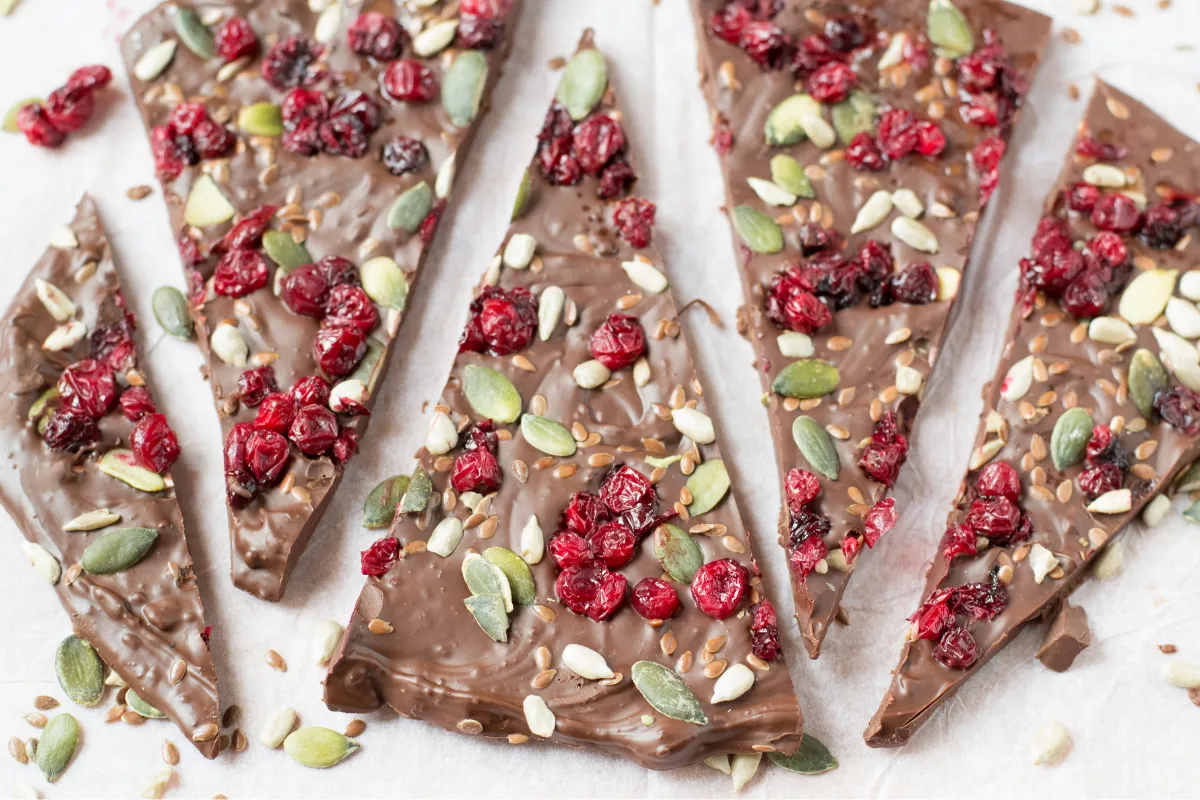
Dark Chocolate Seed Bark
If you want a snack that combines chocolate with some nutrient-dense additions, this is an easy one to keep in the refrigerator.
Ingredients
2 bars dark chocolate, 70% cacao or higher
¼ cup pumpkin seeds
2 tablespoons slivered almonds
2 tablespoons unsweetened dried tart cherries
1 tablespoon chia seeds
Flaky sea salt
Optional drizzle of almond butter
Directions
Melt the chocolate gently in a double boiler or microwave in 30-second intervals, stirring between each.
Pour onto a parchment-lined baking sheet and spread into a thin layer. Sprinkle with pumpkin seeds, almonds, cherries, chia seeds, and a small amount of flaky sea salt. Add an almond butter drizzle if desired.
Refrigerate until firm, then break into pieces and store in the refrigerator.
Dark chocolate, pumpkin seeds, almonds, and chia all contribute nutrients including magnesium, fiber, and healthy fats.
It’s nourishing. It tastes good. Those things can exist together.
Curiosity Changes the Conversation
The goal isn’t to never have cravings.
The goal is to stop treating them as proof that you’ve failed.
Pay attention to the context. Look for patterns. Make sure you’re actually feeding yourself enough. Notice the role that sleep, stress, restriction, and meal composition may be playing.
Then make a purposeful choice.
Sometimes that choice is protein and fruit.
Sometimes it’s a full meal.
Sometimes it’s a piece of really good chocolate.
Curiosity gives us more useful information than guilt ever will.
One step. One layer. One foundation at a time.